


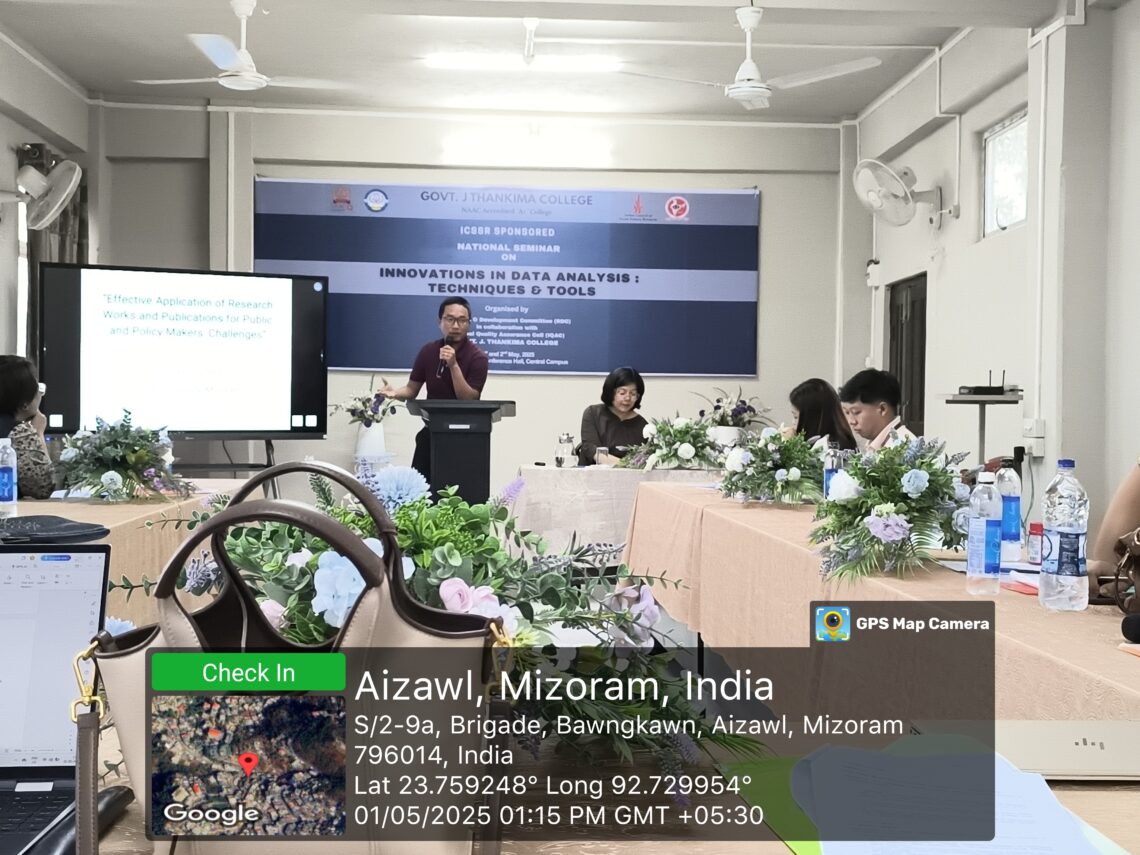
ICSSR Sponsored
Venue: Seminar Hall, RUSA Building, Central Campus, Govt. J. Thankima College
Day 1: May 1, 2025
Inaugural Session (11:00 AM)
The seminar commenced with an introduction and welcome address by Dr. David Lalramchullova, Assistant Professor, Dept. of Geography, and Chairman, RDC. He presented the seminar’s objectives and schedule and introduced the invited speakers.
Rebecca Khiangte, Associate Professor and IQAC Co-ordinator, inaugurated the event with an insightful talk emphasizing the importance of research. She referenced a speech by Prof. Jeffrey Sachs and urged PhD holders to actively contribute to Mizoram’s development. She also motivated aspiring scholars to pursue doctoral studies for both personal and regional growth.
Technical Session I (11:30 AM – 1:00 PM)
Chairperson: Dr. David Lalramchullova
- Lalrintluanga (Asst. Prof., Dept. of Geography)
Topic: Statistical Analysis of Literacy Rate and Population Characteristics in Mizoram (1971–2011)- Detailed the state’s literacy progress and demographic dynamics.
- Highlighted a 35.14% average population growth with a -2% decadal rate.
- Female literacy improvements resulted in positive socio-economic impacts, though not necessarily in increased work participation.
- Growth in higher education and transition of women to domestic responsibilities were noted.
- Dr. Diana Zorinsangi (Asst. Prof., Dept. of Education)
Topic: Artificial Intelligence in Education (AIED): Prospects and Challenges in India- Discussed AI integration in education, referencing NEP2020.
- Noted limited training (only 15% of government school teachers) and low computer literacy in states like Bihar and Mizoram.
- Highlighted infrastructural and psychological barriers, such as lack of training and fear among traditional educators.
- Urged for central funding and better digital access.
- Dr. Gabriel Lalchhandama (Asst. Prof., Dept. of Geography)
Topic: Spatio–Temporal Variability in Meteorological Data of Mizoram- Studied five districts using statistical tools, ITA, ML, and ArcGIS (1986–2023).
- Identified climate change patterns—decreasing rainfall, rising temperatures, especially in spring.
- Aizawl and Kolasib showed decreasing minimum temperatures.
- Stressed the negative impact on agriculture.
Technical Session II (1:00 PM – 2:15 PM)
Chairperson: Dr. Lalthansangi Ralte (Asst. Prof., Dept. of English)
- Dr. David Lalramchullova
Topic: LULC Mapping Using Google Earth Engine and ML- Introduced automated tools like Google Earth Engine.
- ML classifiers like RF, SVM, and CART were employed.
- Found SVM most accurate (>60%).
- Emphasized correct coding and procedure for valid output.
- Dr. Lalrinngheta (Asst. Prof., Dept. of Political Science)
Topic: Applying Research for Policy and Public Benefit- Explored challenges in practical application of research findings.
- Noted misalignment of research topics with societal needs (only 35% target societal development).
- Suggested better dissemination, especially in local languages, and collaboration between policymakers and researchers.
- Recommended incentives for post-PhD research continuation.
- Albert Nuntharmawia (Asst. Prof., Dept. of Management)
Topic: Automated Machine Learning (AutoML) in Business- Reviewed AutoML components—feature engineering, model selection, and tuning.
- Emphasized real-time insights, efficiency, and decision-making enhancement in businesses.
- Zodinsangi (Assoc. Prof., Dept. of Education)
Topic: Collaborative Research in Education- Co-authored with Dr. Diana Zorinsangi.
- Stressed benefits—diversity of ideas, enriched academic quality, global readiness.
- Cited challenges in credit sharing and coordination.
- Advocated for collaboration as a model for students.
Technical Session III (2:45 PM)
Chairperson: Dr. Lalrinkimi Pachuau (Asst. Prof., Dept. of Economics)
- Lalngaihawma (Assoc. Prof., Dept. of Economics)
Topic: Future of Open Access Publishing- Explained various Open Access models—Gold, Green, Diamond, Hybrid.
- Highlighted author rights, Creative Commons licensing, and OAP’s role in free knowledge dissemination.
- Pointed out UGC’s care list disconnection and the importance of digital publishing.
- Lalrinfeli (Assoc. Prof., Dept. of Economics)
Topic: Sustainable Research for a Greener Future- Called for eco-conscious research practices—minimal travel, digital archives, and paperless systems.
- Suggested promotion of ethnic data and cross-disciplinary collaboration to solve environmental problems.
- Dr. Lalthansangi Ralte (Asst. Prof., Dept. of English)
Topic: Effective Communication in Academic Writing- Emphasized listening as a precursor to reading and writing.
- Encouraged evidence-based writing and maintaining academic integrity.
- Introduced EAP (English for Academic Purposes) as a model.
- Academic literacy and integrity were emphasized as foundational.
- Dr. Lalrinkimi Pachuau
Topic: Quantitative Research Tools for Data Analysis- Reviewed 15 papers covering traditional and modern tools.
- Highlighted AI-based surveys, mobile ethnography, and digital phenotyping.
- Discussed ethical challenges and the importance of methodological rigor.
Day 2: May 2, 2025
Session I (10:30 AM – 12:00 PM)
Chairperson: Dr. Gabriel Lalchhandama
A token of appreciation was presented by Principal Prof. JV Nunchunga to Prof. B.S. Mipun and Prof. Rajkumar Giridhari Singh.
Prof. B.S. Mipun (Royal Global University)
Topic: Application of Remote Sensing and GIS in Sustainable Development
- Explained GIS, GPS, and remote sensing with practical applications in hydrology and environment.
- India’s NavIC provides accurate measurements.
- Detailed advanced technologies like hyperspectral, microwave sensing, radar interferometry.
- Mentioned Suomi-NPP’s VIIRS for climate and demographic monitoring.
- Case studies highlighted GIS applications in sustainable planning.
- A brief discussion followed involving faculty members including Sir Ngaiha, Sir Zorama, and others.
Session II (12:15 PM – 1:15 PM)
- Dr. P.C. Lalrindika (Asst. Prof., Dept. of Geography)
Topic: Morphometric Analysis via RS & GIS for Watershed Management- Defined morphometric parameters for watershed planning.
- Suggested ideal sites for terrace and dam construction.
- Advocated RS/GIS for soil-water conservation.
- Dr. Zoramkhuma (Asst. Prof., Pachhunga University College)
Topic: Ecological Quality Assessment of Bairabi–Sairang Railway Using RS & ML- Analyzed impact using indices—dryness, wetness, heat, and environmental quality.
- Utilized ANN prediction for 2027.
- Used GEE, MUSCE, PCA, and Landsat for data extraction.
- Discussion followed with contributions from Sir Zorama and Miss Marini.
Session III (2:15 PM – 3:15 PM)
Resource Speaker: Prof. Rajkumar Giridhari Singh (NEHU, Shillong)
Topic: Data Quality Assurance in Business and Management Research
- Focused on importance of accurate, consistent, and complete data.
- Covered data types (nominal to ratio), quality dimensions, and risks of poor data.
- Stressed the impact of data quality on funding and research validity.
- Dr. Vanlalruati (Assoc. Prof., Dept. of Education)
Topic: Understanding Plagiarism- Defined types—direct, mosaic, auto, source-based, etc.
- Recommended tools—Turnitin, Urkund, Drillbit.
- Suggested proper citation, paraphrasing, and quotations to avoid misconduct.
- Dr. Josephine Lalrindiki (Asst. Prof., Dept. of Management)
Topic: Understanding Research Fraud- Covered types—fabrication, falsification, and plagiarism.
- Cited causes like pressure and lack of oversight.
- Emphasized prevention through ethical practices and peer review.
- Discussed consequences—loss of trust, retraction of papers.
- J. Lalbiakdika (Asst. Prof., Dept. of Management)
Topic: Sustainable Digital Marketing- Promoted eco-friendly digital strategies such as green hosting.
- Addressed benefits—operational efficiency, brand trust, and regulatory compliance.
- Highlighted challenges like knowledge gaps and structural barriers.
Conclusion
The seminar was successfully concluded with a vote of thanks by Sir Zoramthanga, Associate Professor, Govt. J. Thankima College, who expressed appreciation to all speakers, participants, and organizers for their valuable contributions toward innovation in data analysis. The event provided a comprehensive platform for interdisciplinary dialogue, blending academic knowledge with practical tools for research, policy-making, education, and sustainable development.
